

Why AI is Fueling the Growth of Patient Communities
LLMs are missing experience data from trusted patients and doctors
LLMs are missing experience data from trusted patients and doctors
Google’s shift toward AI-generated answers removes the blue search links that so many health publishers relied on for reaching patients. Instead of directing patients to trusted primary sources, AI overviews now summarize content from across the internet — often without clear attribution or context. The vast majority of all health searches on Google (70%-90% depending on your source) start with an AI summary. What’s more, many people are taking their health questions to ChaptGPT, Claude or other AI Search tools and bypassing Google altogether. This is crushing the traditional health endemic publishers.
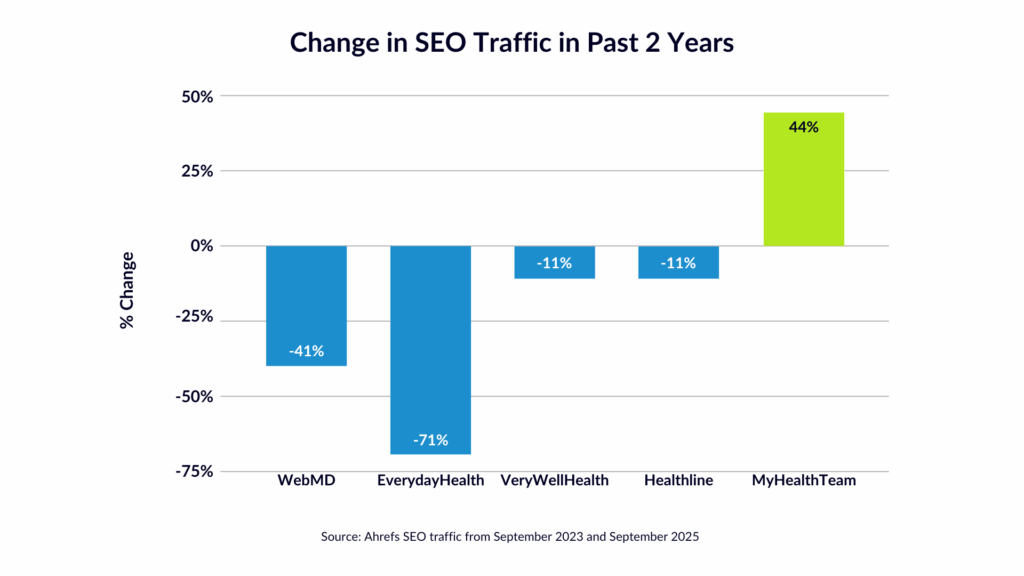
Take a look at sources like Ahrefs, and you’ll see massive drop-offs in SEO traffic for endemic health leaders over the past two years: WebMD SEO traffic down 41 percent, Everyday Health down 71 percent, Healthline and VeryWell Health each down 11 percent – and the list goes on. For better or worse, the SEO traffic from trusted health endemic publishers that patients and marketers relied on in the past, is drying up quickly and will not be a reliable source of engagement with patients anymore.
AI Fueling the Growth of Patient Communities
At the same time, patient communities are flourishing. In the past two years, SEO traffic to MyHealthTeam content grew 44 percent (albeit from a much smaller base). Membership and engagement in patient communities is also accelerating. This year, 35 million people will visit one of the 67 MyHealthTeam patient communities.
As traditional channels dry up and brands try to build authentic connections with the patient population they are competing to serve, investment in communities has taken off. Patient communities are in particularly high demand in rare diseases and oncology. In the last few years, more than 20 pharmaceutical companies have partnered with MyHealthTeam to launch patient communities in 19 different rare diseases and 10 types of cancer.
What Patients Need that AI Isn’t Providing: Validation and Trust
Patient demand for community is also growing in the era of LLMs because patient needs for health information aren’t being met by AI tools. Why?
- They are missing patient input – Someone just diagnosed with a rare disease like myasthenia gravis, or a poorly understood condition like hidradenitis suppurativa, wants to learn from people who have been in their shoes, lived with their condition, tried out different treatments, and figured out ways to live as normal and independent a life as possible. That kind of trust simply can’t be captured in a four-sentence AI blurb referencing a JAMA article, a drug label, or even their doctor.
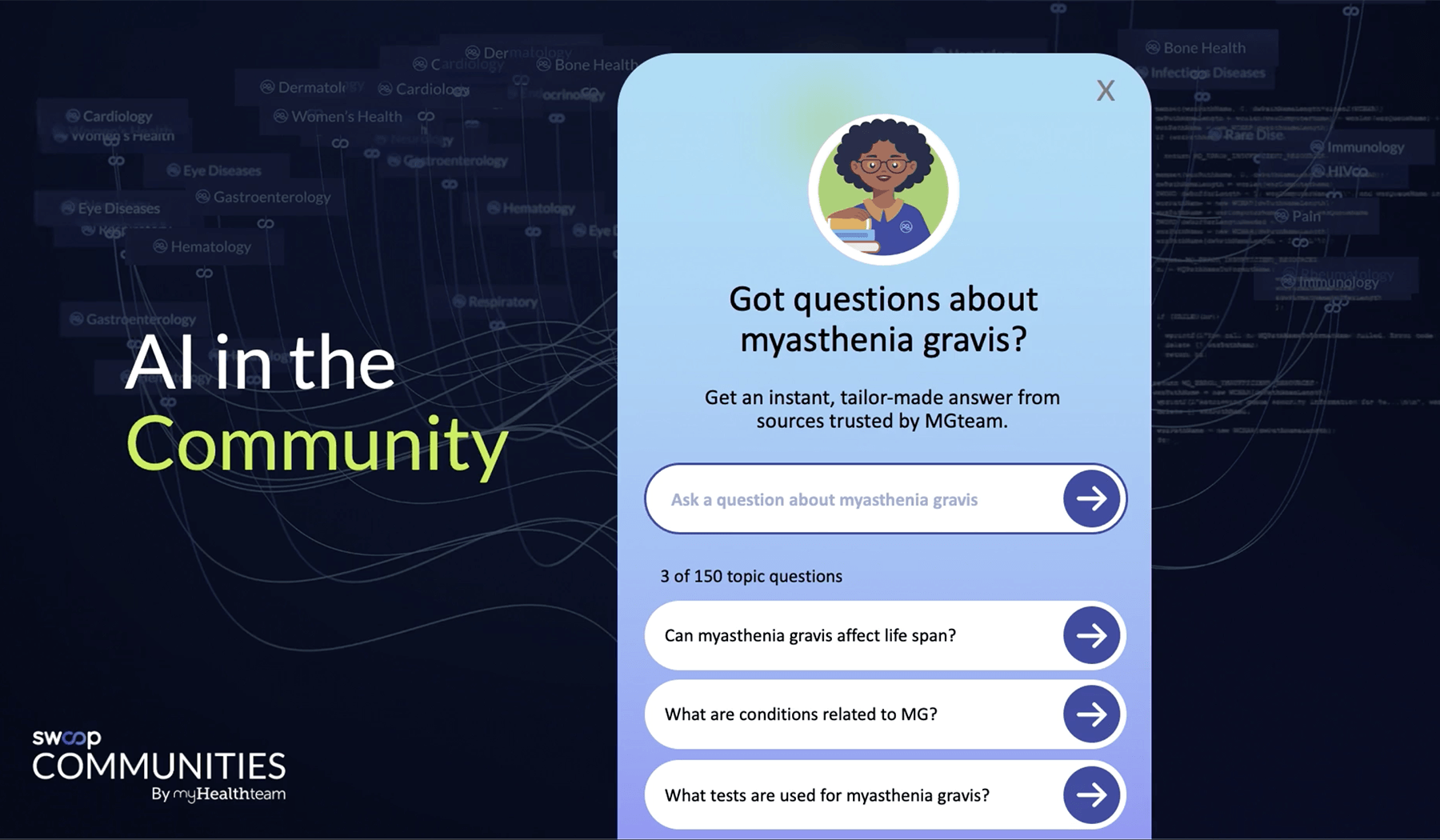
- Patients Don’t Always Know What to Ask – This is an often-overlooked fact, but many patients don’t know what questions to ask and tend to disengage when they see the blinking cursor of ChatGPT waiting for its next mission. We saw that firsthand at MyHealthTeam when we launched our first AI tools in patient communities in 2024. We expected the flood gate of questions to open but saw modest uptake at first. Only when we started listing common questions heard in the community as examples, did we see search volumes start scaling. The person with psoriasis didn’t know that joint pain could be a sign of psoriatic arthritis – so they didn’t ask. The person with vitiligo didn’t know there were new treatments — so they didn’t ask. We have to help patients see around the next corner by showing them and telling them what others like them are going through, and by asking them more about their lived experience.
It’s easy for LLM’s to read every journal, article, and textbook – but it’s hard for LLM’s to get experience data from real patients and doctors.
AI doesn’t replace the need for validation and trust from other patients and experts.
Communities: The New Patient Channel
To paraphrase David Spinks, members come to patient communities for information, but they stay for unity. Patient communities are not a product, but an important patient channel, where members go to talk and learn about their condition, treatments, lifehacks, and lived experiences with each other.
Just as point-of-care media puts brands at the center of the HCP/patient conversation, communities place pharma at the heart of real-world patient-to-patient conversations. More than half of consumers already engage online with others who share their condition.
Brand managers rely on communities to:
- Learn from real-world patient conversations
- Identify hurdles to getting on therapy
- Co-create with patients to inform messaging, support, and product strategies
- Educate and prepare patients to become their own best health advocate with doctors and insurance companies
- Sponsor expert Q&A, patient videos, and articles tailored to a specific indication or symptom
- Deliver measurable improvement in outcomes through faster time to diagnosis, greater adherence to treatments, and more proactive and informed conversations with doctors.
In short, they build authentic connections with the people the brands aim to serve. This isn’t about surface-level impressions. It’s about impact. It’s about showing up where patients are, talking about more than treatments, and doing so with empathy and integrity. While blue links may fade, community endures.

Building the future together
While Google’s blue links in search results are moving further down the page and health endemic publisher SEO traffic may be going away, there are still many opportunities to engage patients in authentic ways.
And communities don’t exist in isolation. Programmatic advertising continues to grow – particularly in targeted TV. MyHealthTeam became part of Swoop so that our pharma partners can reinforce and expand their reach beyond the patient community to everywhere else patients consume media – be it streaming TV, linear TV, the web, or audio.
Patient communities plus programmatic is now part of nearly every drug launch playbook, and the growth in AI answers only seems to be fueling the patient and partner demand for patient communities.
Ready to future-proof your omnichannel marketing strategy?
Learn how our innovative, privacy-compliant solutions can help you navigate the evolving world of search and move beyond blue links and AI Overviews to connect with your audience more effectively.